
The tale of Two Worlds: “Live to Work” & “Work to Live”


From siestas in Spain to Japan’s karoshi culture, or Sweden’s lagom principle, work cultures across the world reveal how little or how much people work and why they work the way they do.
(Siestas - A cultural practice in Spain of taking a midday rest, reflecting respect for natural energy cycles over constant productivity; Karoshi - A Japanese term meaning death from overwork, highlighting the extreme cost of chronic workplace burnout. Lagom - A Swedish philosophy meaning just enough. Which means balance over excess, and sustainability over hustle).
While these cultures shape nations, things are shifting in Worklands all across the globe. A big indicator for us is India’s new Labour Codes and the Right to Disconnect Bill, 2025.
Countries with hustle-culture struggle with overbearing pressures and on-the-toes expectations; whereas many other work cultures consciously protect personal space and mental wellbeing.
What if thriving at work isn’t just an HR metric, but a national advantage? What if thriving workplaces and national happiness are more connected than we think?
Here’s a snapshot of results from Gallup's State of the Workplace and the World Happiness Report
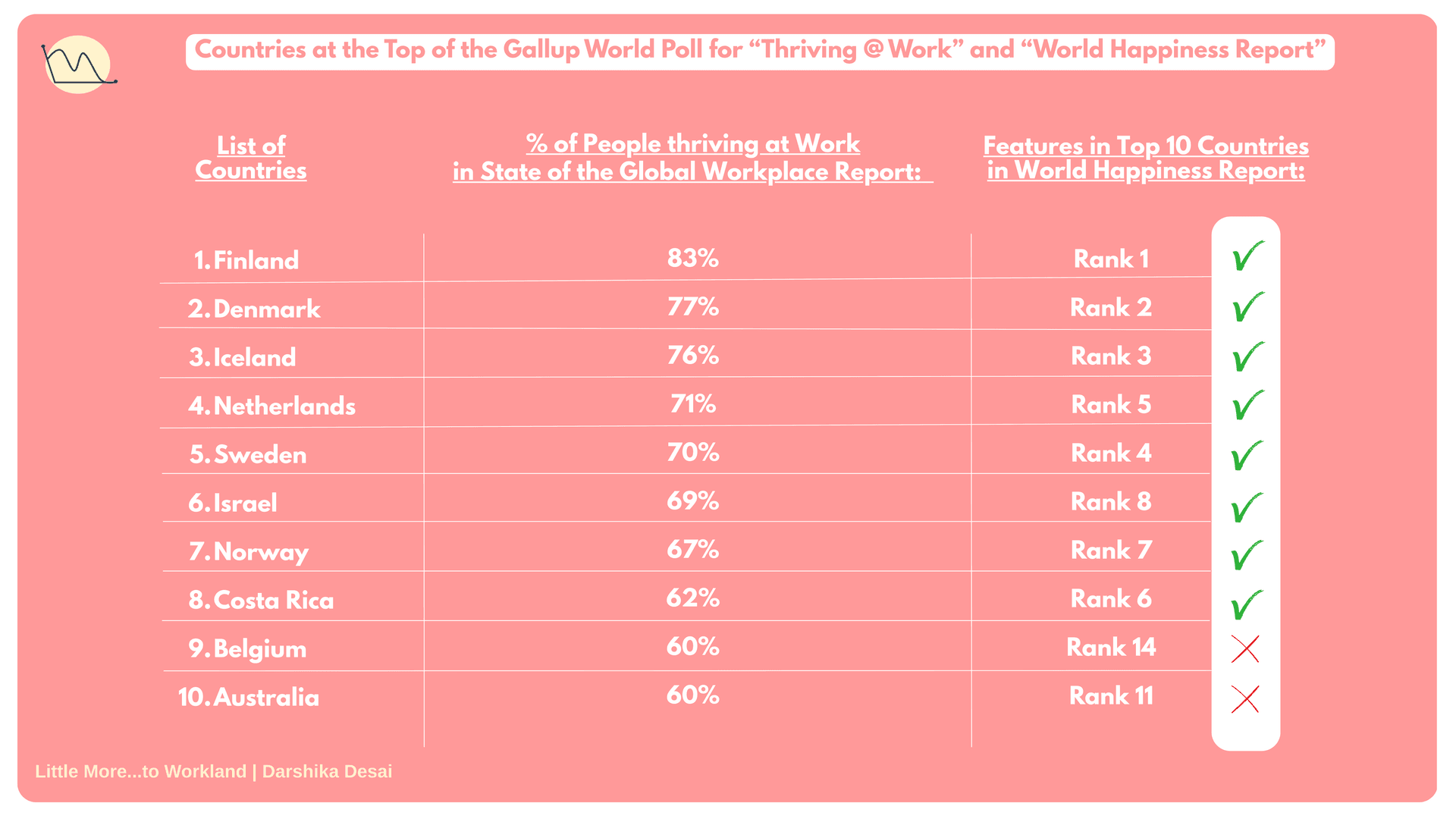
*The World Happiness Report is based on data from more than 140 countries using citizens’ self-assessed Life Evaluations.
*% of People thriving at Work is gathered from the survey "State of the Global Workplace Report" which includes positive daily experiences and low negative emotions (stress, worry, sadness, etc.) among employed adults across 160+ countries.
The results reveal to us how the Top Happiest countries also lead in the percentage of people Thriving at work. This data hints that work engagement is not isolated from broader societal well-being.
Let’s unpack this a little further and understand what influences a country’s happiness index, which is in turn reflected in how these people run their Worklands:
As we can see above, Europe dominates the list with 7 out of the top 10 happiest countries. Let’s explore what are the various factors that differentiate Europe, and can India follow the same practices in near future?
Europe prioritizes: Balance; Rest; Recharge; Autonomy
Asia prioritizes: Growth; Productivity; Competition; Collective progress
Neither is inherently right or wrong. They simply reflect the values and socio-economic histories of their regions.
We are often attracted by the company cultures of European countries and wish to imbibe the perks like shorter work weeks, shorter working hours, more vacation days, etc. But we need to also understand why they are enjoying these perks. Europe didn’t become “relaxed” by accident. Its work culture is the result of centuries of economic evolution, early industrialisation, strong social systems, and cultural philosophies that shaped its priorities. India, on the other hand, is still in a phase of rapid economic growth, population boom, global competition, and post-colonial rebuilding, which naturally creates a hustle-driven environment.
European countries can afford these things because:
1. Europe Has Strong Social Welfare Systems
European countries use tax revenue to support:
- Universal healthcare
- Education
- Unemployment benefits
- Pensions
- Parental leave
- Childcare support
This creates a social safety net that reduces economic pressure on individuals.
(Europe can relax because the state supports people.
Asia works harder because the individual supports the family).
2. Europe Focuses on High-Value, High-Productivity Industries
Europe’s economy is built on:
- Engineering
- Luxury goods
- Innovation
- Pharma/biotech
- Aerospace
- Automation
- Precision manufacturing
These industries generate high output without long hours.
Asia has a mix of:
- Manufacturing
- Services
- Tech
- Agriculture
where longer hours sometimes directly increase output.
Europe produces more value per hour,
Asia produces more hours.
3. Europe Has Smaller Populations But Higher Per-Capita Wealth
Europe doesn’t need massive growth to support huge populations.
Denmark: ~5.8 million
Finland: ~5.5 million
Netherlands: ~17 million
Switzerland: ~8.7 million
Asia:
India: 1.4 billion
China: 1.4 billion
Indonesia: 275 million
Japan & Korea: large urban populations
To support a large population, economies need faster growth, which makes the work culture more intense.
4. Labour Unions in Europe Are Extremely Strong
European unions historically fought for:
- 35–40 hour workweeks
- Strict overtime rules
- Paid vacations
- Worker rights
- Minimum rest periods
- Fair wages
In Asia, unionization is weaker or more regulated, especially in:
- India
- China
- South Korea
- Japan
This naturally results in longer hours and higher expectations.
5. Work-life-Balance embedded in Policies
Europe legally enforces relaxation:
France: Right to Disconnect
Scandinavia: 25-30+ vacation days
Germany: No-work-on-Sundays laws
Spain: Cultural siestas
Netherlands: Normalized part-time work
Asia rarely has such laws because the economic need for growth is higher.
In short, Europe built wealth first, then built work-life balance.
- India’s per-hour productivity is still low
- We’re in a growth stage Europe was in decades ago
- Reducing hours prematurely will slow national development
- Large workforces need upskilling before shorter workweeks are viable
But as burnout rises globally, Asia is slowly borrowing Europe’s balance, while Europe is borrowing Asia’s ambition.
Imagine borrowing the best from each country:
| Country: | What they do best: | What you can adopt: |
| France | Boundaries: With its 35-hour workweek and Right to Disconnect law, employees are not expected to respond to work calls or emails after hours. | Protected personal time |
| Denmark | Trust & outcomes: People are judged by results, not hours, which means less pressure and more ownership. They work shorter hours, enjoy 5-6 weeks of vacation, and rely on high trust between managers and employees. | Result-driven evaluation |
| Spain | Siesta: Spain honours the natural mid-day slump with long breaks and slower afternoons. It’s not laziness. It’s energy science. By resting during dip hours, people revive energy for the remainder of the day | Energy-based work blocks |
| Japan | Discipline: Japan is known for discipline, structure, and Kaizen (continuous improvement). | Structured execution |
| India | Ambition: India’s corporate culture has always been fast, ambitious, and growth-driven. And that’s a strength. (But post-pandemic, workplaces are evolving) | Growth with flexibility |
| South Korea | Speed & Innovation: South Korea has a reputation for intense work ethic, long hours, and perfectionism | Innovation + recovery |
| Netherlands | Flexibility: The Netherlands has one of the highest ratios of part-time workers in Europe. People freely choose reduced hours without being judged for lack of ambition. - The focus is on living a full life - not filling every hour with work. | Hybrid, part-time, staggered hours |
The Shift:
Indian companies are moving beyond attendance-driven cultures, with examples like hybrid work becoming default, performance reviews focusing on deliverables over hours logged, and formal policies around mental health, parental support, and flexibility coming up. The new Indian labour codes defy decades of practices that were unfavourable for employees. From legacy conglomerates introducing trust-based work models to start-ups normalising asynchronous work and no-meeting hours, the shift toward modern, sustainable workplaces is already visible.
A Little More… to Think About:
Maybe the goal isn’t to become Finland.
Maybe the goal is to build workplaces where people don’t need to recover from work to live their lives.
India and Asia will achieve European-style balance - but through a different route, at a different pace, and with their own version of what “less work, more life” looks like.
Links: