
How India's Labour Codes Actually Wrote "Care" Into Work


Most coverage of India's Labour Codes reads like a list: crèches, night-shift consent, equal pay, tick, tick, tick.
What that list misses is the more interesting question - how did "care", historically the most informal, undocumented part of the corporate life, end up embedded into hard law at all? It wasn't one clause in one code. It was a deliberate distribution of care obligations across all four Codes, each one picking up a different piece of the problem. Understanding that design tells you more about what to expect from enforcement than the list ever could.
This piece is written specifically for corporate, office-based employees - not factory or informal workers.
The Design: Four Codes, Four Different Jobs
Here's the part rarely explained: India didn't pass one "Care at Work Act." It consolidated 29 old laws into four Codes, and in doing so, split the care-at-work problem into four separate legal buckets, each handled by whichever Code was best suited to it:
1. The Occupational Safety, Health and Working Conditions (OSHWC) Code
Crèche - "Section 24(3):"The Central Government may make rules to provide for the facility of creche having suitable room or rooms for the use of children under the age of six years of the employees at suitable location and distance either separately or along with common facilities in establishments wherein more than fifty workers are ordinarily employed."
The 50-employee threshold brings most mid-to-large corporate offices into scope. Companies like Myntra and IIFL Capital already run in-house crèches or reimbursement programmes ahead of the compliance deadline.
This rule is also gender-neutral now. A March 2026 Ministry of Labour clarification made creche a gender-neutral entitlement available to all employees, not just women - that’s a real shift from the old maternity-linked rule.
The creche must now be located within 1 kilometre of the establishment, unless it’s in a notified industrial park with a common accessible facility. The old law just said “prescribed distance,” which varied by state and was often unclear.
Night shift consent - Relevant for IT/ITES, BPO, and client-facing roles: women can work night hours (7 PM–6 AM), but only with voluntary, written consent, with employer-guaranteed safe transport and secure facilities. Refusal cannot be held against the employee. (Note: based on legal commentary on Section 43, not the bare statutory text.)
2. The Code on Wages
The code on wages got the economic fairness side - equal pay for equal work, explicitly extended to gender and to transgender employees. Pay parity is fundamentally a wage question, so it sits in the wages code rather than being bolted onto a safety provision.
"Section 3 bars gender discrimination in recruitment, wages, and employment conditions for the same or similar work, extended explicitly to transgender employees." (Note: based on legal summaries of Section 3's effect, not a direct quote.)
3. The Industrial Relations Code
IR Code got the voice and recourse side - Grievance Redressal Committees and Appointment Letters. This is the code that governs the employer-employee relationship structurally, so the mechanism for raising and resolving disputes belongs here.
Many companies gave offer letters informally. A formal appointment letter wasn’t a hard legal requirement for every employee. Now it is mandatory to issue Appointment Letters for every single employee, across all sectors, not just as a practice but as per law.
Section 4(1): "Every industrial establishment employing twenty or more workers shall have one or more Grievance Redressal Committees for resolution of disputes arising out of individual grievances."
The same section mandates women's representation on the committee proportional to the female workforce - a structural detail that matters for how HR-run grievance mechanisms get built in any corporate office of that size.
4. The Code on Social Security
This one got the life-stage continuity side - maternity benefits and provisions supporting flexible return-to-work after leave. Social security has always been the code concerned with income and career continuity across life events, so post-maternity flexibility sits here rather than in a workplace-conditions code.
"Post-maternity flexibility. - Builds on the existing 26-week maternity leave entitlement, with legal commentary noting provisions supporting flexible or remote return-to-work arrangements after maternity leave." (Note: drawn from legal commentary summarizing the Code's provisions)
The four-bucket design maps neatly onto where women's corporate careers actually break down:
The four-bucket design maps neatly onto where women’s corporate careers actually break down:
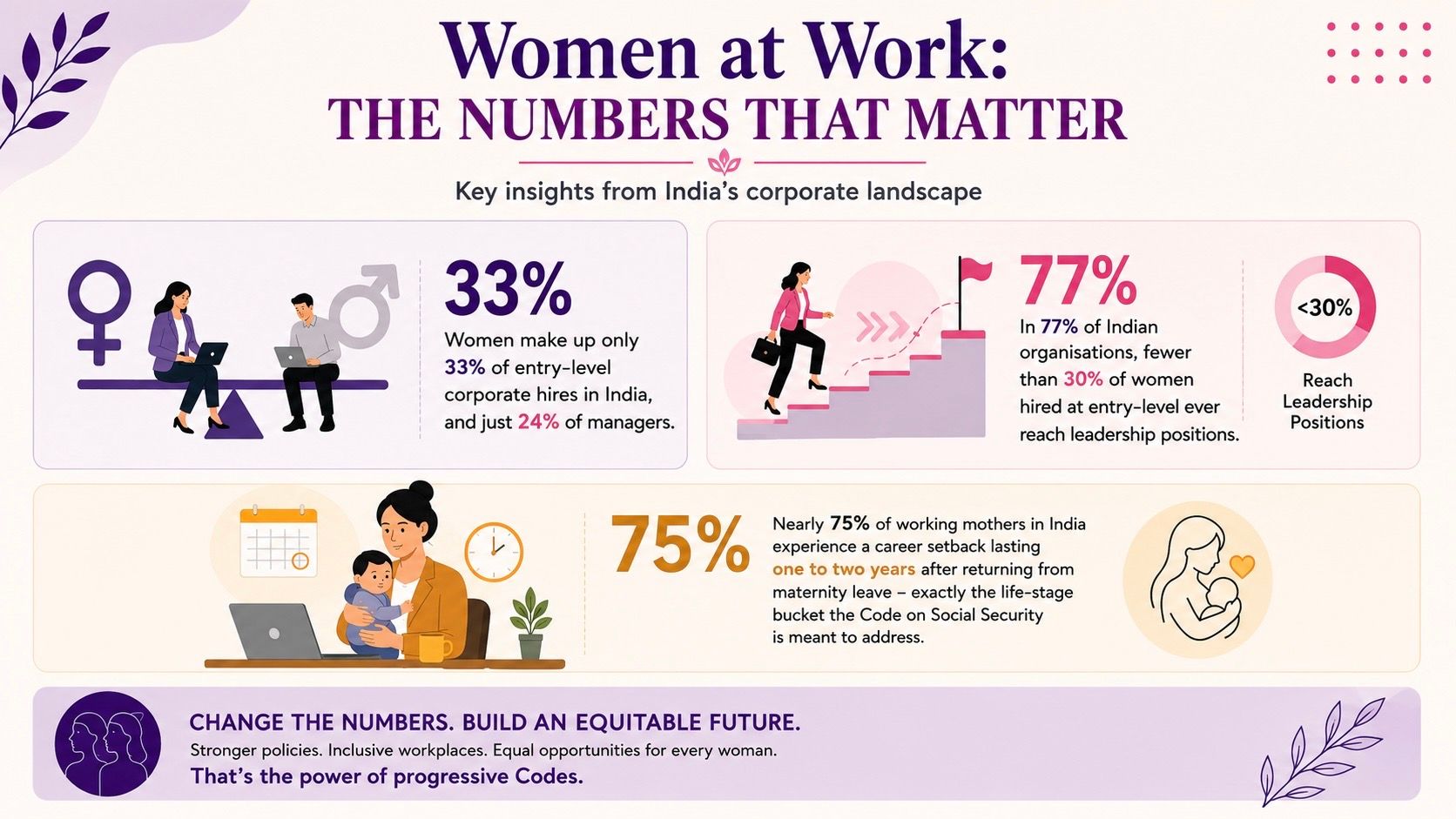
Seen this way, the four-Code design isn't bureaucratic scattering - it's each legal bucket addressing a specific, data-backed point where women's corporate careers are most likely to stall or exit.
A Personal Take: A Coherent Design, an Incoherent Rollout
Here’s where I’ll be candid: I actually think the four-bucket design is smart law-making. Splitting care into physical infrastructure, pay, recourse, and life-stage continuity means each piece sits with the legal framework best equipped to enforce it, rather than being one vague catch-all clause nobody owns.
But a coherent design doesn’t guarantee a coherent rollout. Four buckets means four different rulemaking timelines, four different enforcement mechanisms, and (as the next section covers) four sets of state-level notifications that may not move in sync. A crèche mandate on a central rules document is not the same as a functioning crèche in a mid-sized company’s regional office, especially where HR teams haven’t yet built the compliance muscle to track four different legal obligations at once.
So the honest read is this: the design is sound. Whether you feel the benefit of it in the next 12–24 months depends on something much less elegant than the legal architecture. Whether your company treats each bucket as a genuine obligation or a box-ticking exercise ahead of the first audit.
Here’s the part most coverage skips: Notification and enforcement are two different things, and for corporate employees, the answer to “does this apply to me?” depends on your state.
Labour sits on the Concurrent List, meaning both the Centre and individual states can legislate on it. The Centre’s Central Rules (May 8, 2026) only directly apply to sectors where the Central Government is the “appropriate government” - banking, telecom, railways, and similar. For most private corporate employers, each state has to notify its own rules before the Codes become enforceable for establishments under that state’s jurisdiction.
States are moving at very different speeds. As of mid-2026, a handful, including Gujarat, Bihar, Arunachal Pradesh, and Meghalaya have notified rules under all four Codes. Others, like Karnataka, have notified rules for some Codes but not others. Large states with major corporate hubs, including Uttar Pradesh and Madhya Pradesh, are still at an advanced draft stage.
What this means practically: if your company has offices in multiple cities, your crèche entitlement, grievance committee, or 5-hour break rule may be legally live in your Bangalore office and still pending in your Delhi one and given the four-bucket design, different buckets could even be at different stages of state notification simultaneously.